
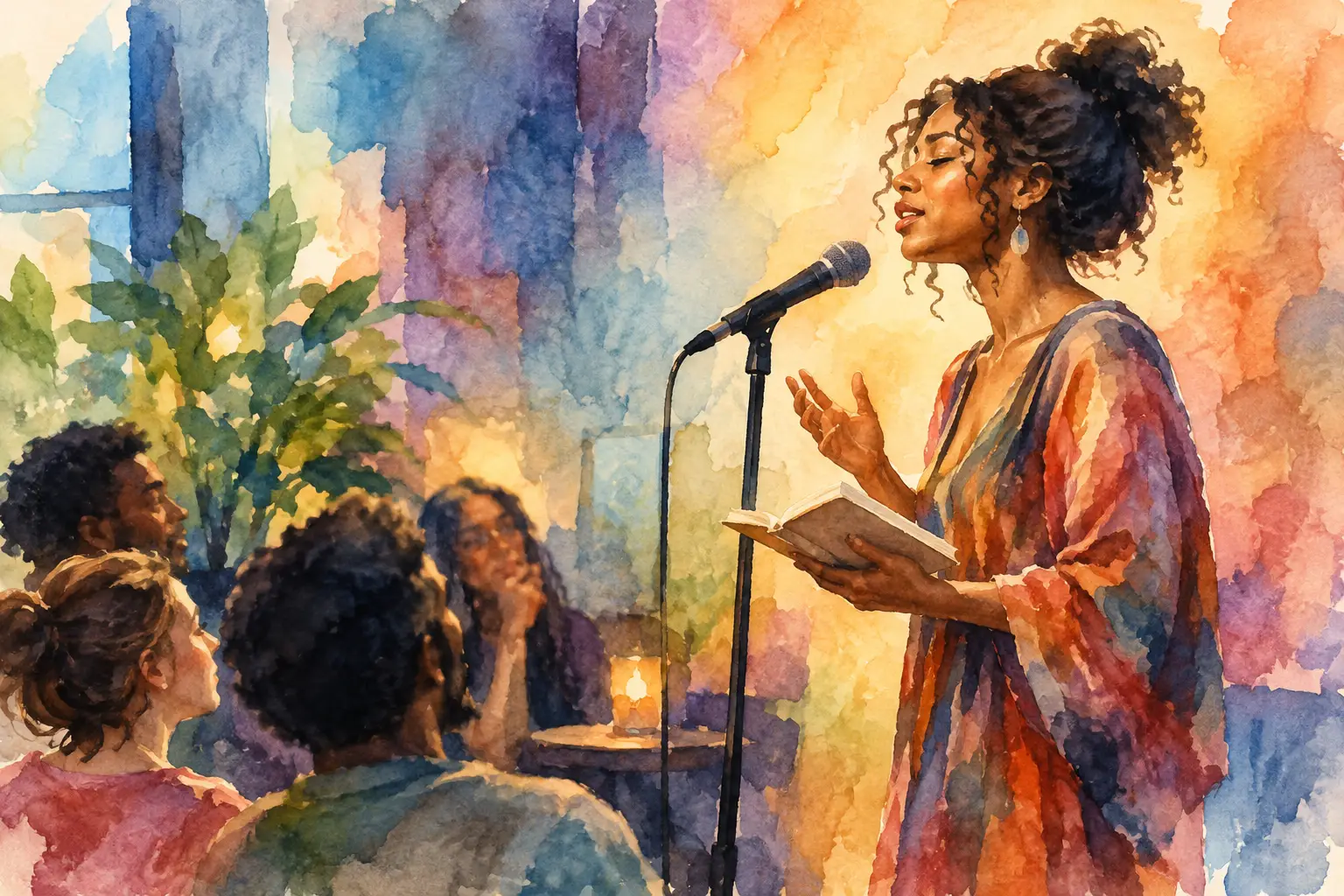
Someone reads a poem alone and it can be lovely. Someone says it aloud in a room full of people who have survived bad dates, long marriages, bereavements, bad decisions and the occasional spectacular romantic blunder, and it becomes something else entirely. A live poetry performance is not a polite encounter with literature. At its best, it is a shared reckoning, with laughs in the awkward places.
That matters because most adults do not need another evening of being talked at. They need to recognise themselves in the mess. They need a line about love that makes them think, “Well, hell. That happened to me.” They may also need permission to laugh about it before they start taking it too seriously again.
Poetry on a page can wait patiently for its reader. Poetry spoken in a room has to earn its keep. It has breath, timing, a raised eyebrow, a pause that lasts just long enough, and the odd word that lands like a dropped frying pan. It is human contact with better line breaks.
Live poetry performance is about the room
A poem is never exactly the same twice when it is performed. The words may be the same, more or less. The room is not.
One audience goes quiet at a line about a lost love. Another bursts out laughing because they have all known somebody just like that lost love and, frankly, good riddance. A skilled performer hears the difference. They know when to let silence do its work and when to take the pressure off with a joke before the whole place begins staring too hard at its shoes.
That is the particular pleasure of spoken poetry. It is not simply a writer reading from a page. It is an exchange between performer and listeners. The audience brings its own history: the relationship that lasted forty years, the affair that should have lasted forty minutes, the children grown and gone, the body changing its mind about what it will tolerate. The poem meets all that baggage at the door and says, come in then.
For adult audiences especially, this can be a rare kind of entertainment. There is no need to pretend life has been tidy. The best material allows joy and disappointment to sit at the same table, possibly with a cheap bottle of wine between them.
Why spoken words can say more than a speech
A good speech usually has a destination. It wants to persuade, explain, celebrate or thank somebody. A poem can do those things, but it has more room to wander around the dodgy bits.
It can hold a contradiction without rushing to fix it. You can still love someone who broke your heart. You can miss a life you were desperate to leave. You can be old enough to know better and young enough, in one regrettable moment, not to act like it. Poetry understands this. It does not always offer a neat moral because neat morals are often what people reach for when they have nothing useful left to say.
Performance gives that honesty a pulse. A voice can make a familiar phrase newly dangerous. A pause after a comic line can reveal the bruise beneath it. Then the next line can give the audience their laughter back. That shifting ground is not a trick. It is how most of us actually live.
The strongest performers do not hide behind fancy language or literary manners. They make the work clear enough to enter and sharp enough to stay with you. You should not need a university seminar, a dictionary or a small torch to find your way through the evening.
What makes a live poetry performance work
Not every poetry event is for every crowd. Some audiences want experimental work, dense references and an earnest discussion afterwards. Fair enough. Others want story, warmth, humour and poems that speak plainly about being alive. Neither crowd is wrong, but a presenter should know which evening they are inviting people to attend.
For community venues, arts programmes, festivals and organisations serving older adults, accessibility is not a compromise. It is a kindness. Clear delivery, emotional stakes and properly paced material allow people to arrive as they are. They do not have to be poetry experts. They only have to have lived a little, which narrows the field hardly at all.
The performer matters as much as the writing. A seasoned poet brings more than a stack of poems. They bring judgement. They understand that a ninety-minute room needs shape: an early laugh, a change of gear, a quieter passage, a little danger, then relief. They know that the audience does not owe them attention merely because they have stood near a microphone.
A performance also needs enough flexibility to suit its setting. A literary festival may need a focused set between other artists. A supper club may want a longer, looser evening. A seniors’ organisation may want work that feels lively rather than patronising. The poetry should be able to stretch or tighten without becoming a lecture with rhymes.
That is why a show such as Candles and Cheap Wine works best as live entertainment rather than a formal reading. It makes room for romance, regret, comic failure and the stubborn hope that keeps people entering relationships despite all available evidence.
The risk is part of the pleasure
There is a reason recorded poetry and printed collections cannot entirely replace the live event. In a recording, the performer cannot feel the silence. In a book, the reader does not hear the other people in the room laugh before they do.
Live performance carries a small, useful risk. A line might land harder than expected. A memory might catch in someone’s throat. A joke might get the biggest laugh of the night from the person who looks least likely to laugh. The artist has to stay present. So does the audience.
That risk is especially valuable now, when much of our attention is chopped into tiny pieces and sold back to us with notifications. Sitting in a room with strangers, listening to one human voice make meaning from experience, is gloriously inefficient. Nobody can scroll through grief. Nobody can skip past a silence that belongs to them.
It does not mean every poem must be heavy. Quite the opposite. Humour gives people somewhere to stand. A filthy little observation, a ridiculous truth about ageing, a well-aimed jab at romance can open a room faster than a grand declaration ever will. Laughter says, “I know.” It is often the first honest thing a crowd says together.
Choosing the right poetry event for your audience
If you are booking a performer, begin with the feeling you want people to carry home. Do you want a formal literary occasion, a lively evening of storytelling, or a performance that moves between laughter and the deeper stuff without warning? The answer will shape the artist, running time and venue better than any vague wish for “something cultural”.
Think about the practical character of the room too. An intimate audience can handle quiet detail and close conversation. A larger hall needs vocal presence, pace and poems with a clear emotional line. A mixed-age crowd often responds best to material that is specific in voice but universal in experience: love gone wrong, family, ageing, desire, embarrassment, loneliness, hope.
There is no need to dress poetry up as medicine, though it can be medicinal in the way a good laugh sometimes is. Give people an evening with a real voice, a few lines worth remembering and a chance to hear their own lives named without fuss. That is plenty.
The next time you see a poetry event listed, do not ask whether you understand poetry well enough. Ask whether your heart has ever had a good shit kicking, whether you have laughed at the wrong moment, whether you have loved somebody complicated. If so, take a seat. The room may have a poem waiting for you.